Elisar Nurmagambet
•
May 28, 2026
Light on the Wall
The order that organized global business for the last seventy years is no longer there. The replacement hasn't arrived. We're in the gap between the two, and the gap is where most of the confusion lives
In April, China issued two regulations that took effect the day they were written. One says foreign companies can be investigated for restructuring their supply chains away from China. The other says compliance with US sanctions is itself a punishable act under Chinese law. [1] [2] Two weeks later, Beijing blocked Meta's acquisition of a Singapore-registered AI company called Manus because the founders were Chinese, applied a doctrine called substance-over-form, and barred two executives from leaving the country. [3] [4] The whole thing took less than a month from law to enforcement.
Around the same time, US Customs detained 7,300 shipments in a year and denied release on 77 percent of them. [5] The Justice Department made tariff evasion a criminal enforcement priority. A wood products company in Florida pleaded guilty to buying $30 million of plywood that had been transshipped through Malaysia from China. They weren't the importer. They were the buyer. Under a new doctrine of willful blindness, that was enough for a $6.4 million criminal fine. [6]
In Britain, regulators fined Apple's Irish subsidiary for processing payments to a Russian developer through the App Store. The specific finding was that Apple's third-party due diligence providers had failed to surface reporting about Russian corporate ownership changes. [7] The providers were doing exactly what the industry has done for twenty years. The regulators had decided that was no longer enough.
The pattern in each story is the same. The rule changed, the enforcement preceded the guidance, and the standard of care shifted faster than the tools companies use to meet it. This is what multi-polarity looks like at the operational level. Not big strategic competition between nation-states, but small specific decisions made by compliance officers, general counsel, and supply chain managers who have to act on incomplete information against rules that contradict each other across jurisdictions.
The result is fear. Not panic. Fear is quieter than panic. It looks like delayed decisions, expensive workarounds, and conservative defaults that erode competitiveness over time. It looks like Meta paying for an AI acquisition that anyone reading Mandarin financial commentary could have predicted would be blocked. It looks like banks closing accounts they don't have to close, exiting markets they could have stayed in, and pricing in risk that exists mostly in the imagination because no one can see clearly enough to price it accurately.
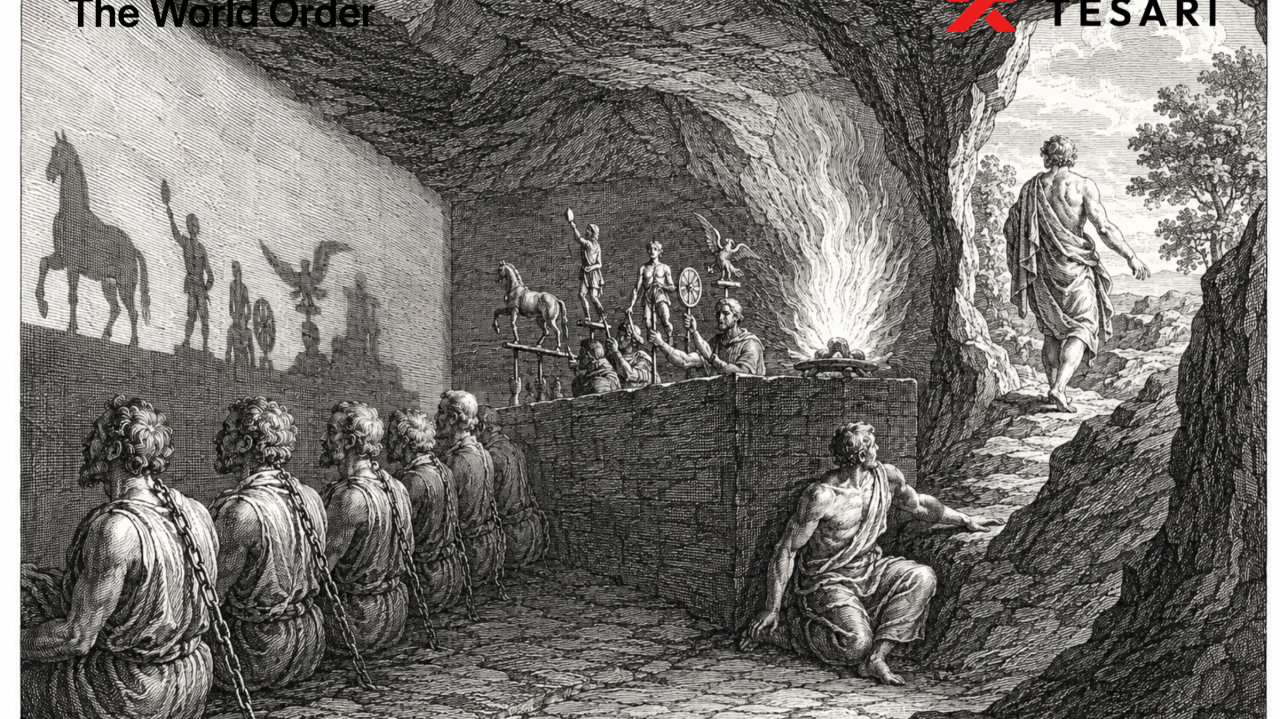
Plato described people sitting in a cave watching shadows move across a wall, mistaking the shadows for the things themselves. Most of the fear in the current environment is shadow-fear. The Singapore registration that looked clean was a real document. The MOFCOM-adjacent academic who published commentary predicting the block was a real signal, published in Mandarin months before the decision came down. None of these were hidden. They were just unread, untranslated, or unconnected to each other in the analyst's mind.
The work is to turn around. And what you find when you turn around is that the world is more legible than the shadows suggested. The threats are real but readable. The signals exist. The information is there. The fear was always larger than the thing itself.
This is what we are doing at Tesari. The system reads what people don't read because the languages are hard, the sources are scattered, and the relationships are buried in unstructured text across dozens of jurisdictions. It connects what is connected. It draws on commercial datasets, public registries, regulatory filings, news in native languages, court records, and the open and harder-to-reach corners of the web, all in the context of the specific jurisdiction and discipline that matters for the case at hand.
In the Manus case, the system surfaced the Mandarin blog post by the MOFCOM-adjacent academic, traced his ties to the ministry, mapped the Singapore registration against the Chinese nationality of the founders, and produced an assessment that the deal would face regulatory intervention regardless of the Singapore wrapper.
Five minutes. Three hundred dollars. Months before the block.
In the Boise Cascade case, the system would have surfaced the federal search warrant at Horizon Plywood's Florida warehouse, mapped the supplier's claimed Malaysian operations against actual manufacturing capacity, identified the price discrepancy from real Malaysian production, and produced a willful blindness risk assessment. The procurement officer who needed that assessment didn't have it. A $6 million fine followed.
In the Apple Ireland case, the system would have tracked Sberbank's divestiture, identified JSC New Opportunities as the newly formed acquirer, surfaced the reporting in Russian business press, and produced the audit trail that OFSI later found absent.
A good investigator does this kind of work naturally. The discipline has existed for decades inside intelligence agencies, investigative journalism, and financial crime units. The institutional knowledge is real. What no single investigator has is fluency in every language, familiarity with every registry, mastery of every jurisdiction's tradecraft, and the time to apply all of that to thousands of cases at once. Cases like the ones above take an experienced team weeks to assemble. A large multinational needs thousands of them a year. The math has never worked.
It works now because the system keeps the investigator in the lead while multiplying what they can do, and because the discipline itself has been encoded into the platform. A living network of experts contributes their tradecraft as skills into the agentic ontology: cybercrime specialists, sanctions and export control experts, beneficial ownership investigators, crypto tracing analysts, supply chain forensics professionals, financial crime veterans, and country experts who are native speakers across more than two hundred jurisdictions. Each is rare on their own. Together they are something that has never existed in one place. They do not staff the work. They teach the system how to do the work, jurisdiction by jurisdiction and discipline by discipline. Every case run on Tesari benefits from the encoded discipline of all of them at once. The agents inherit the tradecraft. The next investigation runs on the accumulated skill of the network.
The point of all of this is not that the risk isn't real. It is. The point is that the solution is there. You can shine the light. The signals that predict outcomes are visible to anyone with the tools to read them. The fear is mostly shadow-fear, born of inability to see clearly rather than absence of light to see by.
When companies can see clearly, they make better decisions. They stay in markets others are abandoning. They walk away from deals before the regulators do. They keep relationships their competitors are severing in panic. They allocate capital with confidence, take measured risk, and operate competitively in jurisdictions where the rest of the industry is paralyzed by uncertainty.
The post-1945 order is not coming back. The replacement is not arriving on any predictable timeline. But the gap between them is not a void. It's a working environment that companies will operate in for the next decade and beyond. The question is whether they operate in it blindly or with sight.
Plato's freed prisoner does not stay on the wall side of the cave. He turns toward the fire. Then he walks out of the cave entirely and sees the sun. The story is not really about the cave. It is about the choice of what to look at.
That's the whole story.
References
[1] mayerbrown.com — Mayer Brown, "China Expands Its Playbook: New Industrial Supply Chain and Counter-Extraterritoriality Regulations Create Direct Compliance Conflicts for Multinationals," May 2026.
[2] morganlewis.com — Morgan Lewis, "China Issues New Regulations on Countering Foreign Extraterritorial Jurisdiction: What MNCs Need to Know," April 15, 2026.
[3] cnbc.com — CNBC, "China blocks Meta's acquisition of AI startup Manus," April 27, 2026.
[4] aol.com — The Independent, "China bars AI boss from leaving country after Meta takeover," 2026.
[5] cbp.gov — US Customs and Border Protection, Forced Labor Enforcement and UFLPA Statistics Dashboard.
[6] justice.gov — US Department of Justice, "Boise Cascade Pleads Guilty and Is Sentenced for Violating the Lacey Act for Its Role in a Timber Trafficking Scheme," April 27, 2026.
[7] irishtimes.com — UK Office of Financial Sanctions Implementation penalty on Apple Distribution International Limited, March 2026, as reported by The Irish Times.
The allegory of the cave appears in Plato's Republic, Book VII.


